Showing posts with label Drawn and Quaterly. Show all posts

Sunday, July 4, 2010

Exit Wounds, by Rutu Modan

Rutu Modan is an Israeli graphic novelist whose book Exit Wounds (2007) was well received by fans of the genre and critics, quickly appearing on the “best of graphic fiction” list in the New York Magazine as well as Time. A year later, the book received the Eisner Award for the best graphic album. This award, the Oscar of the comic book, is named after Will Eisner, who coined the expression “graphic novel” in 1978 after publishing A Contract With God. By now, Modan’s Exit Wounds has been translated into ten languages.[1]

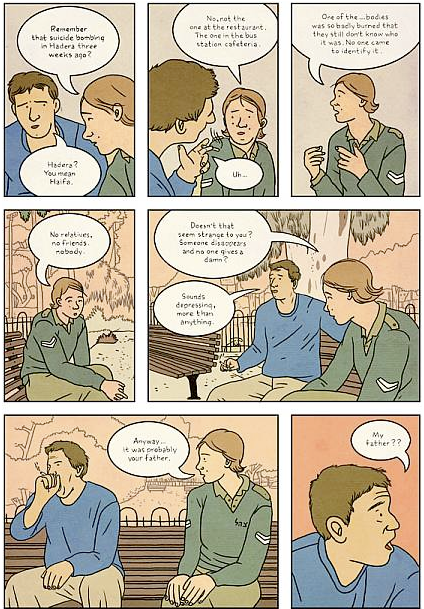
Exit Wounds is a tale of mystery and love set between Tel Aviv and Hadera in Israel. Koby Franco, a shy and disillusioned taxi driver, has been estranged from his father for two years. The story opens when Koby receives a phone call from Numi, a soldier that informs that his father is a casualty of a bombing. The young woman, who had recently been his lover, believes that he is the unidentified victim because she has not heard from the man in several days and she gets a glimpse of a keepsake in the news reports. With great reluctance, Koby agrees to follow Numi on the search to find clues that may help locate his father. In the search to discover the truth, in a region beset by the war, Modan captures how people cope with trauma and how simple human affection develops.

Exit Wounds is an elegant but unsentimental display of line drawings and simple, yet insightful dialogues. Modan uses the ligne claire style, of straight even lines without the use of hatching to create shading, which was popularized by Hergé in Les Aventures de Tintin. The backgrounds are very realistic, even though they are often drawn in monochromatic colors. The watercolors utilized in the book are beautiful, luscious. Overall, it is possible to assert that the author paid great attention to the every detail of image and dialogue.

Besides being about love and romance, Exit Wounds is also about death. They mystery of the unidentified body, that unites Koby and Numi, was inspired by the documentary No 17, in which the director David Ofek attempts to identify the only unidentified victim of a bombing of a bus on the outskirts of Tel Aviv. In the afterword to Exit Wounds, Modan relates the impact the film had on her, noting that “We would like to think that if we disappear at least someone would notice. But sudden, brutal deaths are actually around all of us, anywhere, anytime, not just in Israel. Ever death feels sudden and brutal, even those called natural.”[2] For Modan, death is a central part of life, and Exit Wounds shows death – even the most cruel – as also being something that reunites people.

The search to establish the body’s identity takes the reader back and forth between Hadera and Tel Aviv. Interestingly, the political situation in Israel is only mentioned through various allusions: bombings, overcrowding of the morgue and the loss of children in the war. Even though conflict is tangible in the background, it is only represented in an indirect manner. To explain this important blank space she says:
When the reality around you is so complicated or too frightening, people tend to detach themselves from it. We cannot live our lives fearing what is going to happen next, we have to protect ourselves. I know it seems strange that Palestinians are not mentioned in the story. Israelis prefer not to think about the context of terror. […] It is too complicated to think of the context (and it depends on who you ask), and depressing, too.”[3]
Even though I immensely enjoyed reading Exit Wounds, I did feel uncomfortable at the complete absence of the life of Palestinians. Why was Modan completely incapable of naming the political problem – the Israeli occupation – and only capable of alluding to it? We must ask the question: is not this amnesia part of the problem?

Israelis may prefer “not to think about the context of terror” but this does not justify not doing so. However, some Israelis object to the occupation on moral grounds, and have called for the creation of an independent Palestinian state based on the pre-1967 borders. In 1993, it seemed that the occupation would finally end with the signing of the Oslo Agreement in Washington and that the withdrawal from the occupied territories would lead to the creation of a Palestinian State. Unfortunately, as we know, the Oslo Agreement did not lead to the desired results. In fact, it only permitted Israel to maintain occupation in a more “sophisticated form”. The result is an increasingly militarized and belligerent state – as the raid on the international aid flotilla on its way to Gaza has certainly proven. As Yeshayahu Leibovitz, an Israeli philosopher, warned in 1968: “A state governing a hostile population of 1.5 to 2 million foreigners is bound to become a Shin Bet (Security Service) state, with all that this implies for the spirit of education, freedom of speech and thought and democracy. Israel will be infected with corruption, characteristic of any colonial regime”. [4] That’s a context worth thinking about.

Drawn & Quarterly
Rutu Modan - Mixed Emotions - New York Times - Blog


[1] Kobi Ben-Simhon, Books, Hors-série, no. 2, avril-mai 2010, p.49.
[2] Rutu Modan. Exit Wounds. Montreal, Drawn & Quarterly, 2008, p. 180-181.
[3] Ibid.
[4] See Tanya Reinhart. Israel/Palestine. How to End the War of 1948. New York, Seven Stories Press, 2005 (Second Edition).

Friday, June 18, 2010

We Are On Our Own, by Mariam Katin

There are fears regarding the disappearance of historical memory of the Holocaust both because of the belief that it would pass into oblivion with the death of its survivors, but also because of the revisionism of Holocaust denial, more recently expressed by the President of Iran, who in 2005 called it a “myth”. There is also an alarming moral desensitization partly due to the visual memorialization of the events through the endless repetition of archive images, as well as their decontextualization, which could also pose problems for Holocaust remembrance. Yet the Holocaust being both personal (family) history and global (global/national) history therefore requires the recording of testimonies of Holocaust survivors.[1] They are a necessity for the writing of collective and individual histories, as well as the memorialization of the Holocaust. In an interview, Katin remarked on her own experience with the memory of the Holocaust: "Well, you know, the Holocaust was such a rarely talked-about subject. My family, the schools, no one talked about it, even in Israel. And at the same time it was very personal for me. The loss, the pain. Every production connected to the war, even if I would not read it or watch it, was expected to be very tragic and dark".[2]

We Are On Our Own is a graphic novel and a memoir by Miriam Katin describing the survival of a Jewish mother and her child during WWII. Like Spiegelman’s Maus, her memoir is part of a larger project of memorialization of the Holocaust. Published in 2006, We Are On Our Own was the first graphic novel written by the 63 year old author. The mention of the authors age is not anecdotal as it implies that she was three years old during the Second World War. It was as a young child that she experienced clandestinity during a voyage full of violence, death, betrayals.[3]

In her graphic novel, the author Katin retells the story of her escape from Budapest on foot after the invasion of the city by the Nazi army. After faking their own deaths, Katin and her mother – whose pseudonym in the book is Esther Levy – are forced to take drastic measures to survive. Levy assumes the identity of a poor servant with an illegitimate child, burns all of her belongings and flees to the countryside on foot while her husband is away at the front fighting for the Hungarian Army. The pair’s survival requires trusting the generosity of strangers and often fleeing without knowing where to go. Out of fear of being questioned about her papers, Levy even allows herself to be seduced by a German officer. The advice given by a stranger sets the tone for the journey: “Be smart. Be crafty. Find a way to vanish”.

The story also expresses the author’s lifelong struggle with faith following the events in her childhood. While wartime is illustrated in black and white, Katin’s anxieties regarding religion as an adult are illustrated in color. Unfortunately, this theme could have been better developed in the imaging. A postscript helps the reader better understand Katin’s intentions while discussing her struggle with faith. Dealing with the long-term effects of the Holocaust on the author (and her family, again explained in postscript) encourages the reader to reflect on the Holocaust in a historical sense, but also in its long lasting effects – still felt by the survivors and the second generation, like Katin and Spiegelman.

A strong point of the graphic novel is that Katin presents a feminist perspective in telling her family’s tale of survival. Historians have often evaluated the participation of women during the World Wars, in terms of work and involvement in the armed forces. Unfortunately, the everyday lives of people in the war-torn urban centers and the countryside seem to have mostly been left aside. In We Are On Our Own, Katin explores the everyday life of peasantry, along with acts of determination, craftiness and social solidarity. The life Esther Levy during the war demonstrates the extent to which networks of solidarity formed in the countryside, sometimes without every member’s approval. Her life also exhibits the overall strength and courage of a woman during WWII, giving the book a strong feminist undertone. In a way, the book feels very empowering.

We Are On Our Own is a elegantly drawn graphic novel. The novelists’ drawings carry the weight of the subject and the suspense with great talent and poignancy. However, the narrative structure can be clumsy at times. The reader is transported from 1945 to the 1970s without any warning. In addition, Katin often jumps between the perspectives of the mother and the child. Nonetheless, to call the reader into the story is to force an active rather than a passive participation. For instance, the temporal jumps or fragmented narratives typical of postmodern writing do not allow the reader to simply absorb information. Readers must engage with texts in order to understand them. But even subjectively re-experiencing the suffering of the Holocaust at an emotional level can be only a fraction of the reality. [4] 

Telling personal histories through the juxtaposition of pictures and text conveys a message that would otherwise be difficult to put into words. On the subject of her own art, Katin has said: "In pictures and few words I am trying to find the line connecting events, people, causes and results". By encouraging the active participation of a reader in the act of memorialization, Katin contributes to the history of the Holocaust from a Jewish woman’s perspective.


Drawn & Quarterly, Publishers
Stories in Pictures and Words, Miriam Katin


[1] http://www.du9.org/Miriam-Katin,1151
[2] Lisa A. Costello, History and Memory in a Dialogic of "Performative Memorialization" in Art Spiegelman's "Maus: A Survivor's Tale", "The Journal of the Midwest Modern Language Association", Vol. 39, No. 2. p. 22.
[3] Lisa A. Costello, History and Memory in a Dialogic of "Performative Memorialization" in Art Spiegelman's "Maus: A Survivor's Tale", "The Journal of the Midwest Modern Language Association", Vol. 39, No. 2. p. 23.
[4] http://www.du9.org/Miriam-Katin,1151